poe@pcbamake.com


Choosing the right overseas PCB manufacturer is one of the most important decisions for any electronics company. A reliable factory does not just deliver boards on time—it protects your design, ensures consistent quality, and supports your business for the long term.
1. Certifications and Quality Systems
A professional PCB manufacturer should follow international quality standards. At minimum, look for:
ISO 9001 for quality management
UL certification for safety compliance
IATF 16949 if you produce automotive electronics
ISO 14001 for environmental management
These certifications show that the factory meets established process controls and is regularly audited by a third-party authority. Always ask for valid certificates, not only the logos.
2. Manufacturing Capabilities and Technical Depth
A reliable PCB partner should be transparent about what they can build and where their limits are.
Minimum trace/space
Controlled impedance capability
Available copper thickness
HDI, blind/buried vias, via-in-pad options
Materials supported (FR4, high-frequency laminates, Rogers, polyimide, etc.)
Factories with incomplete or outdated capability sheets are often not operating at the level required for today’s high-density or high-speed designs.
3. Equipment and Production Line
The quality of a PCB depends heavily on the equipment in the factory. When evaluating a supplier, check whether they use:
Automated exposure machines
Laser drilling for HDI
AOI and flying-probe testers
X-ray inspection
CNC routing and V-cut machines
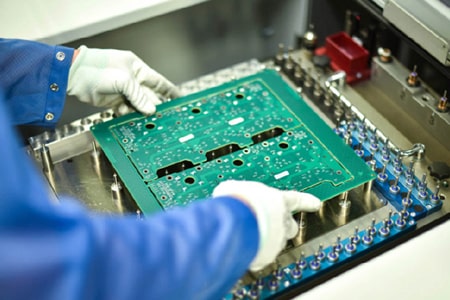
Modern equipment means higher accuracy, fewer defects, and more stability in mass production. Many reputable suppliers provide photos or virtual factory tours—use this to assess whether the production line looks organized and up-to-date.
4. Quality Control and Testing
A reliable factory will always prioritize quality control. Ask how they manage:
Incoming material inspection (IQC)
In-process inspection (IPQC)
AOI for every inner and outer layer
Electrical testing before shipment
Final inspection and packaging
If the factory cannot clearly explain each step of their QC process, it is a sign of potential risk.
5. Engineering Support and Communication
Strong engineering support is often the difference between a smooth project and weeks of delay. A reliable PCB manufacturer should offer:
DFM (Design for Manufacturability) review
Gerber file checking
Stack-up consultation
Quick and clear technical communication
For overseas buyers, responsiveness is especially important. Evaluate the supplier’s communication speed during the quotation stage—it often reflects how they will support you after production begins.
6. Delivery Performance and Supply Chain Stability
On-time delivery is critical for global buyers. Ask for:
Average lead times for prototype and mass production
Record of on-time delivery rate
Material sourcing partners (e.g., Isola, Shengyi, Rogers)
Stable material suppliers and consistent schedules indicate a mature factory with good management.
7. Customer Reviews and Industry Reputation
Finally, check the factory’s track record:
Customer testimonials
Case studies
Years in the PCB industry
Whether they serve well-known brands
A manufacturer with long-term international clients is usually more reliable than a factory offering low prices but little history.
Conclusion
Evaluating a PCB factory is not only about price—it is about capability, communication, consistency, and trust. A reliable overseas PCB manufacturer will be transparent, technically strong, and committed to helping your product succeed in the market. Taking the time to assess these factors will protect your project from costly mistakes and help you build a long-term manufacturing partnership.
If you have PCB/PCBA/OEM/ODM needs, please contact us, We will reply within 2 hours, and complete the quotation within 4 hours or less upon request.
Delivery Services

Verified by

Link Us on