Orders@pcbamake.com

While it offers clear pricing advantages, OSP also introduces manufacturing constraints that must be carefully managed.
What Is OSP Surface Finish?
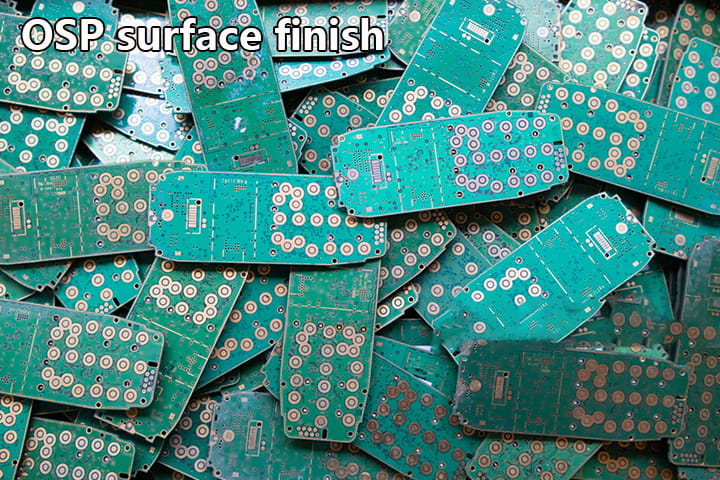
OSP is an organic coating applied to copper to prevent oxidation.
Unlike metallic finishes, OSP Is extremely thin,Relies heavily on process control and timing
Advantages of OSP in PCBA
1. Lowest Surface Finish Cost
OSP is typically the most economical option, making it attractive for:
Consumer electronics
Large-volume, cost-sensitive products
2. Good Initial Solderability
For first-pass SMT:
OSP provides good wetting
Flat copper pads support standard components
Key Limitations in PCBA Manufacturing
1. Poor Multi-Reflow Performance
OSP degrades after:
Multiple reflow cycles
Extended thermal exposure
This limits its use in complex assemblies.
2. Short Shelf Life
OSP boards require:
Controlled storage
Short time between PCB fabrication and assembly
Logistics delays significantly increase risk.
3. Narrow Process Window
OSP demands:
Precise reflow control
Clean handling
It leaves little margin for manufacturing variation.
Best Application Scenarios for OSP
Low-density PCBA
Single-pass reflowHighly cost-sensitive projects
👉 For higher density or reliability requirements, ENIG or immersion silver are usually better choices.
Related reading:
ENIG Surface Finish in PCBA: When Is ENIG the Best Choice?
Immersion Silver Surface Finish for PCBA Applications
OSP is not a “low-quality” choice—but it is a high-discipline choice.
When conditions are right, it delivers excellent cost efficiency.If you have PCB/PCBA/OEM/ODM needs, please contact us, We will reply within 2 hours, and complete the quotation within 4 hours or less upon request.
Delivery Services

Verified by

Link Us on