Orders@pcbamake.com


Industrial control systems and robotics require stable PCBA performance under continuous operation, electrical stress, and demanding working environments. For manufacturers, the challenge is not simply getting a prototype to work, but ensuring the assembly process can consistently deliver reliable products at scale.
A well-controlled pilot run helps identify manufacturing risks early and establish a reliable foundation for mass production.
Reliability Validation During Pilot Production
Pilot production should focus on identifying potential failure points before volume manufacturing begins.
For industrial control boards, servo drives, and robot control systems, key validation areas include:
Solder Joint Reliability: Inspect BGA, fine-pitch ICs, connectors, and power component solder joints to identify assembly defects.
Thermal Performance: Evaluate heat dissipation around high-power components under actual operating loads.
Electrical Functionality: Verify power stability, signal communication, and functional performance.
Mechanical Reliability: Pay particular attention to connector integrity and solder joints on boards exposed to continuous vibration.
Testing requirements should be determined by the product's operating conditions. Temperature cycling, vibration testing, and other environmental tests may be necessary for demanding applications.
IPC-A-610 Class 2 and Assembly Quality Control
IPC-A-610 Class 2 provides an important workmanship acceptance reference for industrial electronic assemblies.
During PCBA production, quality control should focus on solder joint acceptance, component placement, polarity, solder coverage, and potential assembly defects such as bridging or insufficient solder.
For complex industrial boards, AOI and X-ray inspection help identify defects that cannot be reliably detected through visual inspection alone.
However, workmanship acceptance is only one part of reliability assurance. Critical applications may require additional electrical, thermal, and environmental validation based on product specifications.
From Pilot Runs to Consistent Mass Production
One of the biggest challenges in industrial PCBA manufacturing is maintaining the same quality level when production moves from small batches to larger volumes.
Three factors are particularly important:
BOM & Component Control: Verify component specifications, sourcing channels, and approved substitutions to minimize supply-related risks.
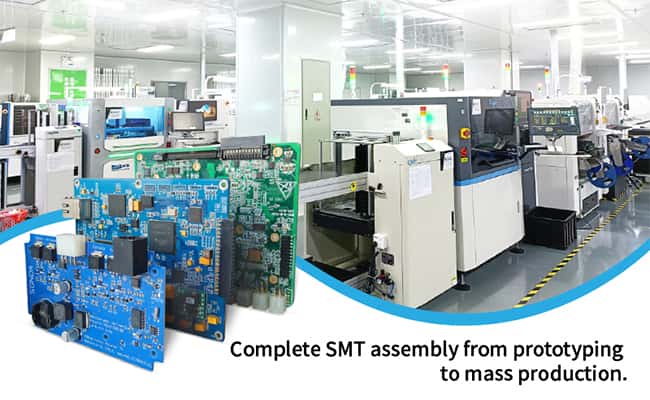
Process Consistency: Establish validated solder paste printing, placement, and reflow parameters during pilot production, then maintain them across batches.
Inspection & Testing: Apply appropriate AOI, X-ray, ICT, and FCT procedures according to board complexity and customer requirements.
Pilot-run feedback should be documented and translated into process improvements before mass production. This reduces repeated defects and helps maintain manufacturing consistency.
Industrial PCBA Manufacturing Support from PCBAMake
PCBAMake provides PCB fabrication, component sourcing, and turnkey PCBA services for industrial electronics manufacturers.
Our capabilities include:
From engineering review and pilot production to batch manufacturing, we support industrial control and robotics PCBA projects with integrated manufacturing and quality control.
Developing an industrial robot or control system PCBA project?
Send us your Gerber files, BOM, and assembly requirements. Our team can review your project and provide manufacturing recommendations and a quotation.
If you have PCB/PCBA/OEM/ODM needs, please contact us, We will reply within 2 hours, and complete the quotation within 4 hours or less upon request.
Delivery Services

Verified by

Link Us on