How to Adjust Temperature and Pressure in HASL for Different PCB Materials
Hot Air Solder Leveling (HASL) remains one of the most widely used surface finishing processes in PCB manufacturing due to its cost-effectiveness and robust solderability.
However, one critical factor often overlooked is this:
Different PCB materials require different temperature and pressure settings during the HASL process.
Improper parameter control can lead to:
Warpage
Delamination
Uneven solder coating
Reduced reliability
How to optimize HASL parameters based on PCB material types.
Understanding the HASL Process
HASL involves:
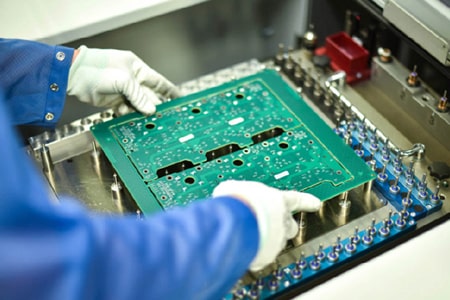
Immersing the PCB into molten solder (typically 245–265°C)
Removing excess solder using high-pressure hot air knives
Two key process variables:
Solder bath temperature
Air knife pressure
These directly affect coating thickness, flatness, and thermal stress on the board.
1. FR-4 Standard PCB
FR-4 is the most common PCB substrate, but its thermal tolerance depends on Tg (glass transition temperature).
Recommended Settings:
Temperature: 245–255°C
Air pressure: 0.4–0.6 MPa
Key Considerations:
Standard Tg (130–140°C) FR-4 is prone to thermal stress
Excess temperature may cause:
Layer separation
Board warping
👉 For standard FR-4, stability is more important than aggressive leveling.
2. High Tg FR-4 PCB
High Tg materials (≥170°C) offer better thermal resistance.
Recommended Settings:
Temperature: 255–265°C
Air pressure: 0.5–0.7 MPa
Advantages:
Better resistance to multiple thermal cycles
Reduced risk of delamination
👉 Higher temperature improves solder wettability without damaging the substrate.
3. Aluminum PCB (Metal Core PCB)
Aluminum PCBs are widely used in LED and power applications, with strong thermal conductivity.
Recommended Settings:
Temperature: 245–255°C
Air pressure: 0.6–0.8 MPa
Key Challenges:
Rapid heat dissipation → uneven solder coating
Risk of insufficient wetting
👉 Solution:
Slightly increase air pressure to ensure uniform leveling
Maintain stable immersion time
4. Rogers / High-Frequency PCB
High-frequency materials (e.g., Rogers) are sensitive to thermal expansion mismatch.
Recommended Settings:
Temperature: 240–250°C
Air pressure: 0.4–0.6 MPa
Key Risks:
Delamination due to CTE mismatch
Material deformation under high heat
👉 Lower temperature is critical to protect dielectric properties.
5. Flexible PCB (FPC)
Flexible PCBs are extremely sensitive to heat and mechanical stress.
Recommended Settings:
Temperature: 230–245°C
Air pressure: 0.3–0.5 MPa
Key Risks:
Severe deformation
Material shrinkage
Surface damage
👉 HASL is generally not recommended for FPC — ENIG or OSP is preferred.
Key Process Optimization Tips
1. Control Immersion Time
Typical range: 2–5 seconds
Too long → thermal damage
Too short → poor coating
2. Optimize Air Knife Angle & Distance
Improves solder uniformity
Reduces bridging and uneven thickness
3. Preheating is Critical
Reduces thermal shock
Especially important for:
High-frequency PCB
Multi-layer boards
4. Monitor Board Thickness & Copper Balance
Thin boards → lower pressure
Heavy copper → higher temperature needed
Common Defects and Causes
Defect
| Possible Cause |
| Warpage | Excess temperature / uneven heating
|
| Uneven | coating Improper air pressure
|
| Delamination | Thermal stress too high |
| Solder bridging | Low air pressure or poor leveling |
There is no universal HASL parameter setting.
The correct approach is:
👉 Adjust temperature and pressure based on PCB material properties
A reliable PCB manufacturer should:
Understand material-specific behavior
Apply precise process control
Balance solderability and structural integrity
Final Insight
In modern electronics manufacturing, process control defines product quality.
Choosing a supplier who understands material-driven parameter optimization is far more important than simply choosing the lowest price.

 Orders@pcbamake.com