Orders@pcbamake.com

PCB Thickness Explained
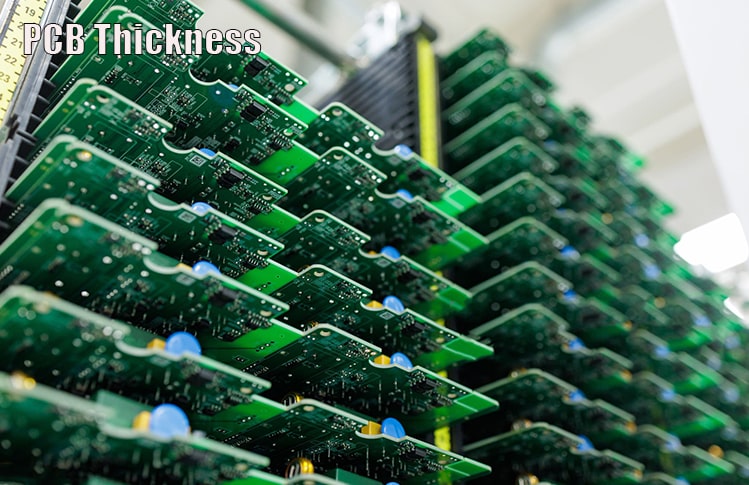
When designing a printed circuit board, many buyers focus on materials, layer count, or surface finish—but PCB thickness is often overlooked.In reality, PCB thickness directly affects mechanical strength, electrical performance, thermal behavior, and overall reliability.
At PCBAMake, we frequently help global customers optimize PCB thickness to ensure their products perform reliably from prototype to mass production.
The industry standard thickness is 1.6mm (0.062”), but this is far from the only option. Depending on design requirements, PCBs can be made thinner or thicker, with custom tolerances to meet specific mechanical or electrical needs.
By combining different core materials and prepreg layers, we can achieve a wide range of finished PCB thicknesses to meet various design requirements. Our supported PCB thickness range extends from 0.2mm up to 7.0mm, covering both standard and custom configurations. Common thickness options include 0.2mm, 0.4mm, 0.5mm, 0.6mm, 0.8mm, 1.0mm, 1.2mm, 1.5mm, 1.6mm, 2.0mm, 2.3mm, and 3.175mm. In addition to these standard options, custom PCB thicknesses can be provided based on specific project needs, ensuring optimal mechanical strength, electrical performance, and manufacturing reliability.
Why PCB Thickness Matters More Than You Think
Choosing the wrong PCB thickness can lead to unexpected problems later in production or use. Here’s why it matters:
1. Mechanical Strength & Durability
Thicker boards provide better rigidity and are ideal for:Industrial equipment,Automotive electronics,Boards with large connectors or heavy components.
Thinner boards are suitable for:Compact consumer electronics,Wearable devices,Space-constrained designs.
2. Electrical Performance
PCB thickness affects:
Impedance control
Signal integrity in high-speed designs
Power distribution stability
For high-speed or RF designs, thickness must be carefully controlled to meet electrical requirements.
3. Thermal Management
Thicker PCBs can help:
Improve heat dissipation
Reduce board warpage under thermal stress
This is especially important for power electronics and LED applications.
Some commonly used PCB thicknesses include:
0.8mm / 1.0mm – Compact and lightweight designs
1.6mm – Industry standard for most applications
2.0mm and above – High-strength or industrial use
PCBAMake supports custom PCB thickness based on your design files and application needs, ensuring consistency from sampling to volume production.
How PCB Thickness Affects PCB Assembly (PCBA)
PCB thickness also impacts assembly quality:Thinner boards may require special handling to avoid warping during SMT.Thicker boards may need adjusted reflow profiles.
As a one-stop PCB & PCBA manufacturer, PCBAMake optimizes both fabrication and assembly processes together—reducing risks and improving yield. we don’t just manufacture according to files—we review and support your design:Thickness evaluation based on application,Manufacturing feasibility feedback,Stable thickness control for batch production,Full support from prototype to volume orders.
Reliable thickness. Consistent quality. Scalable production.
If you have PCB/PCBA/OEM/ODM needs, please contact us, We will reply within 2 hours, and complete the quotation within 4 hours or less upon request.
Delivery Services

Verified by

Link Us on