Orders@pcbamake.com

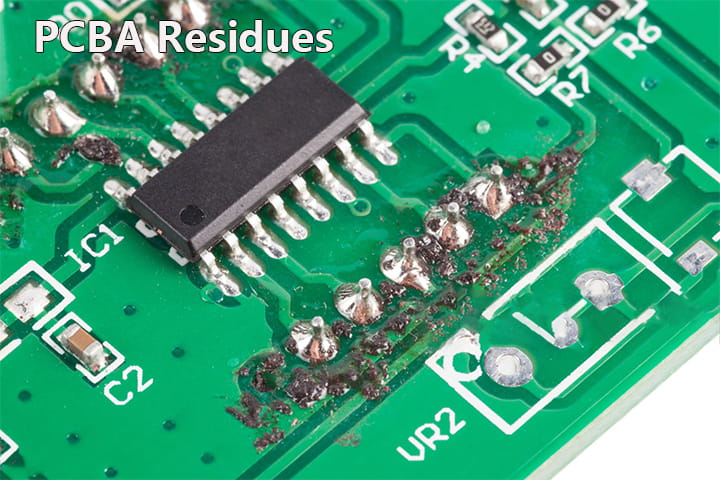
Residues left on PCBAs after assembly can significantly compromise long-term reliability. These contaminants—both inorganic and organic—can trigger corrosion, insulation failure, and electrical instability, especially under harsh environmental conditions.
1. Effects of Inorganic Residues
Corrosion Risk:
Inorganic residues such as halide ions and metal salts can cause electrochemical corrosion in humid environments. This leads to oxidation of solder joints, pads, and component leads, weakening structural integrity. For example, silver-containing solder may release silver ions, accelerating electrochemical migration.
Reduced Insulation Performance:
These residues lower insulation resistance and increase leakage current between conductors. In high-voltage or high-frequency applications, this can result in signal interference or malfunction.
Electrochemical Migration (ECM):
Under moisture and electric fields, ionic residues can migrate and form conductive dendrites, leading to short circuits—especially in high-density assemblies.
2. Effects of Organic Residues
Insulating Film Formation:
Organic residues such as rosin and oils can form insulating layers on contact surfaces (e.g., connectors, switches), increasing contact resistance and potentially causing open-circuit failures over time.
Moisture Absorption:
These residues are hygroscopic and can absorb moisture, further degrading insulation. In humid environments, this may lead to delayed startup issues or unstable performance in devices like displays.
Adhesion and Contamination:
At elevated temperatures, organic residues may become sticky, attracting dust and particles, which worsens contact reliability and may require frequent maintenance—particularly in communication equipment.
3. Special Risks of White Residues
White residues are typically flux by-products, including polymerized rosin, unreacted activators, and halide compounds. These substances can absorb moisture, expand, and become difficult to remove.
Even in dry conditions, they may release corrosive ions due to temperature fluctuations, leading to delayed failures over time.
4. Combined Impact Mechanisms
Environmental Sensitivity:
Higher humidity and temperature accelerate corrosion and electrochemical migration, significantly increasing failure risks.
Time-Dependent Degradation:
Residue effects are cumulative—initial issues like increased contact resistance can evolve into severe failures such as short circuits or open circuits.
Process Dependency:
Residue type is closely related to the soldering process. For instance, improperly cleaned water-soluble flux can leave high levels of halide residues, greatly increasing corrosion risk.
5. Case Insights
Electrochemical Migration: A display manufacturer observed functional failures within six months due to uncleaned PCBAs; performance was restored after proper cleaning.
Corrosion Rate: Tests show that PCBAs with halide residues corrode over three times faster under 85°C/85% RH conditions.
Contact Resistance: Rosin residues can increase contact resistance by 10–100×, potentially leading to open circuits.
Conclusion:
Effective PCBA cleaning is essential to eliminate residues, ensuring electrical reliability, preventing latent failures, and extending product lifespan—especially in high-reliability applications.
If you have PCB/PCBA/OEM/ODM needs, please contact us, We will reply within 2 hours, and complete the quotation within 4 hours or less upon request.
Delivery Services

Verified by

Link Us on