Orders@pcbamake.com

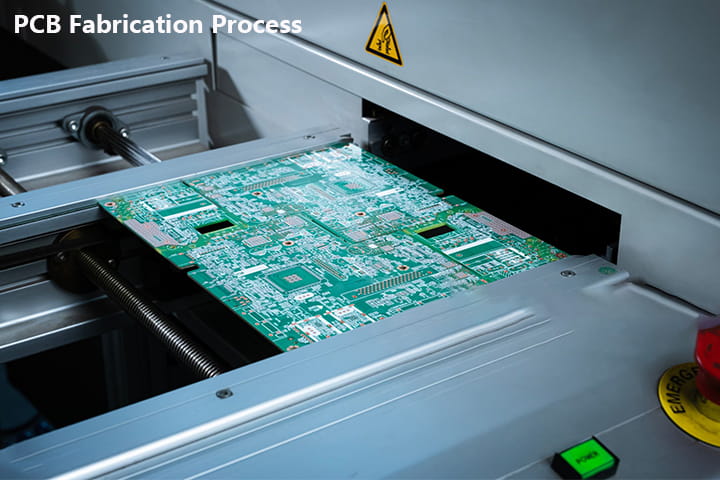
Printed Circuit Board (PCB) fabrication is a precise, multi-step manufacturing process that transforms circuit design data into a functional bare board. Understanding this process is critical for optimizing performance, reliability, and manufacturability.
1. Design Data Preparation (DFM Check)
The process begins with Gerber files, drill files, and stack-up information provided by the customer. Before production, a Design for Manufacturability (DFM) review is conducted to verify:
Trace width and spacing compliance
Annular ring adequacy
Drill hole tolerances
Layer alignment feasibility
Early DFM optimization reduces yield loss and prevents costly rework.
2. Material Selection and Cutting
The base material is typically FR-4, but high-frequency or high-speed applications may require materials like Rogers or high-Tg laminates.
The copper-clad laminate (CCL) is cut into production panels based on the required board size and production efficiency.
3. Inner Layer Imaging and Etching
For multilayer PCBs:
A photoresist is applied to the copper surface
UV exposure transfers the circuit pattern onto the resist
Chemical etching removes unwanted copper
This step defines the inner layer circuitry, directly impacting signal integrity.
4. Layer Alignment and Lamination
Inner layers are stacked with prepreg (insulating material) and bonded under:
High temperature
High pressure
Vacuum conditions
Precise alignment is critical to ensure via connectivity and layer registration accuracy.
5. Drilling (Mechanical & Laser)
Holes are drilled to create:
Through holes (PTH)
Blind and buried vias (for HDI boards)
High-precision CNC drilling machines or laser drilling systems are used depending on design complexity.
6. Hole Metallization (Plating)
After drilling:
Hole walls are cleaned and activated
Electroless copper deposition creates a conductive layer
Electroplating thickens the copper
This ensures reliable electrical interconnection between layers.
7. Outer Layer Imaging and Etching
Similar to inner layers, outer layers undergo:
Photoresist application
Pattern exposure
Copper etching
This defines the final external circuitry, including pads and traces.
8. Solder Mask Application
A solder mask layer is applied to:
Prevent solder bridging
Protect copper traces from oxidation
Improve electrical insulation
Common colors include green, black, blue, and red, with green being the industry standard.
9. Surface Finish
Surface finishes enhance solderability and protect exposed copper. Common options include:
HASL (Hot Air Solder Leveling)
ENIG (Electroless Nickel Immersion Gold)
OSP (Organic Solderability Preservative)
ENIG is widely used for fine-pitch and high-reliability applications.
10. Silkscreen Printing
Component markings, logos, and reference designators are printed on the board surface to assist assembly and inspection.
11. Electrical Testing (E-Test)
Each PCB undergoes electrical testing to verify:
Open circuits
Short circuits
Netlist integrity
This step ensures the fabricated board matches the original design.
12. Profiling and Final Inspection
The board is routed or V-scored into its final shape. Final quality checks include:
Visual inspection
Dimensional measurement
Surface quality verification
Key Factors Affecting PCB Fabrication Quality
To achieve high reliability, attention must be paid to:
Material selection (Tg, dielectric constant, loss tangent)
Trace design (impedance control for high-speed signals)
Via structure (affects signal integrity and thermal performance)
Surface finish compatibility with assembly processes
The PCB fabrication process is a tightly controlled sequence of mechanical and chemical operations. Each step—from DFM review to final inspection—directly impacts the board’s electrical performance and long-term reliability.
For engineers and buyers, understanding this process enables better design decisions, cost control, and supplier selection—especially when targeting high-density, high-speed, or high-reliability applications.
If you have PCB/PCBA/OEM/ODM needs, please contact us, We will reply within 2 hours, and complete the quotation within 4 hours or less upon request.
Delivery Services

Verified by

Link Us on